
Why Glycans Are Found on Nearly Every Cell in Your Body
Every cell needs a way to identify itself, sense its surroundings, and interact with other cells. Glycans help make that possible.
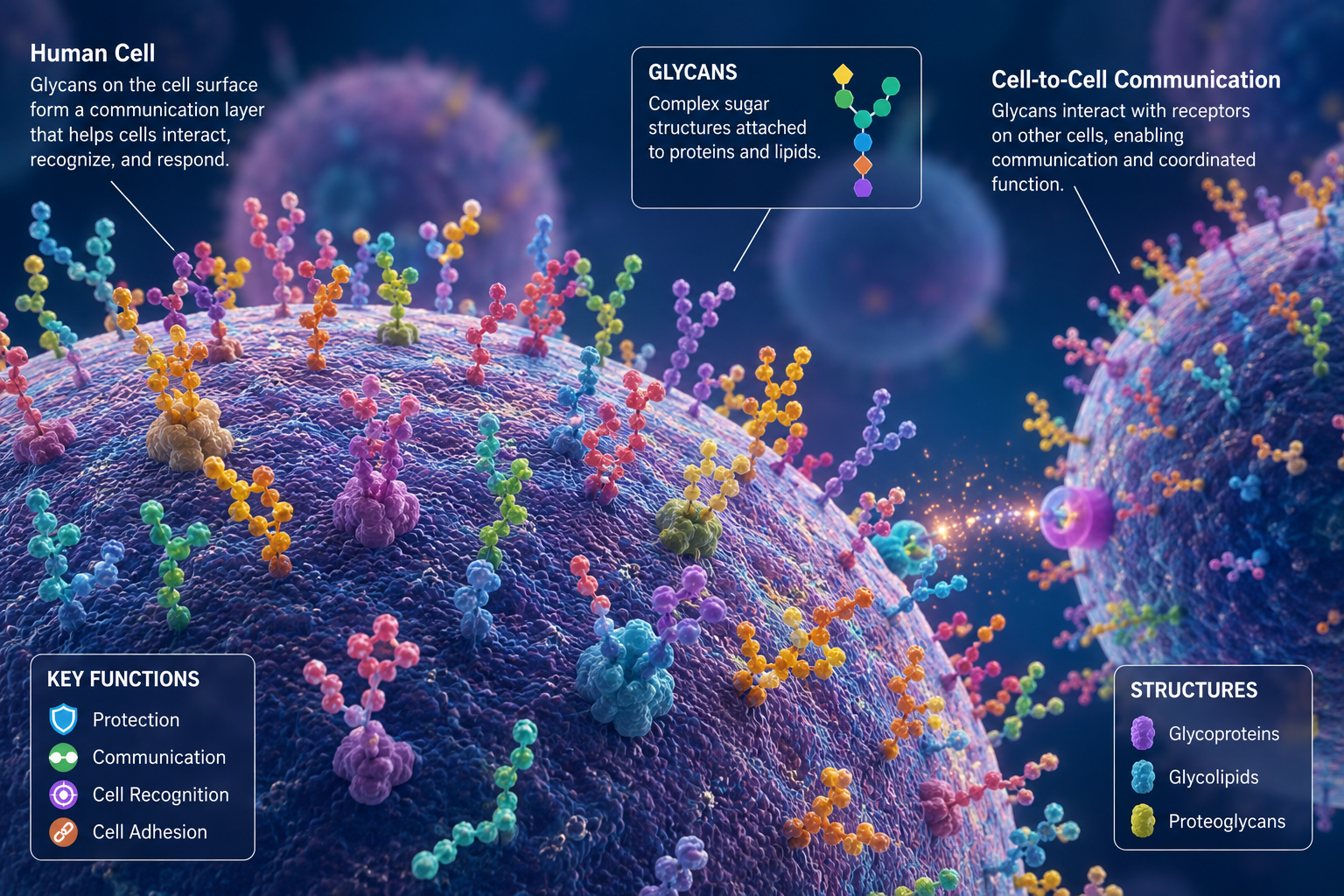
Image: Scientific illustration showing healthy human cells covered with colorful glycan structures that help form the communication layer on their surfaces.
When most people picture a human cell, they imagine a simple round structure with a membrane around the outside and a nucleus in the middle.
But the surface of a cell is far more complex than that.
Many cells are covered by a dense outer layer made from carbohydrates attached to proteins and fats.
This carbohydrate-rich coating is known as the glycocalyx.
You can think of it as a highly organized biological interface between the cell and everything around it.
It helps the cell protect itself, recognize other cells, receive information, and respond to its environment.
Glycans are a major part of that system.
They are found on glycoproteins, glycolipids, and other structures on the surfaces of nearly every type of cell in the human body.
Glycoproteins are essential for life. They help cells recognize and communicate with one another, making them fundamental to virtually every system in the body.
Your Cells Need More Than a Protective Wall
A cell membrane cannot simply be a wall that keeps everything out.
Cells need to interact continuously with their surroundings.
They must be able to:
- recognize neighboring cells
- receive chemical signals
- respond to changes in their environment
- attach to certain cells and tissues
- distinguish between familiar and unfamiliar structures
- coordinate normal biological activity
The glycans extending from the cell surface help create the interface where much of that interaction takes place.
Researchers describe glycans as having information-bearing roles in cell-to-cell recognition and interactions between cells and their surrounding environment.
This means they are not merely decorative sugars attached to the outside of cells.
They are part of the biological information system that helps cells determine what they are encountering and how they should respond.
Source: Essentials of Glycobiology — Biological Functions of Glycans
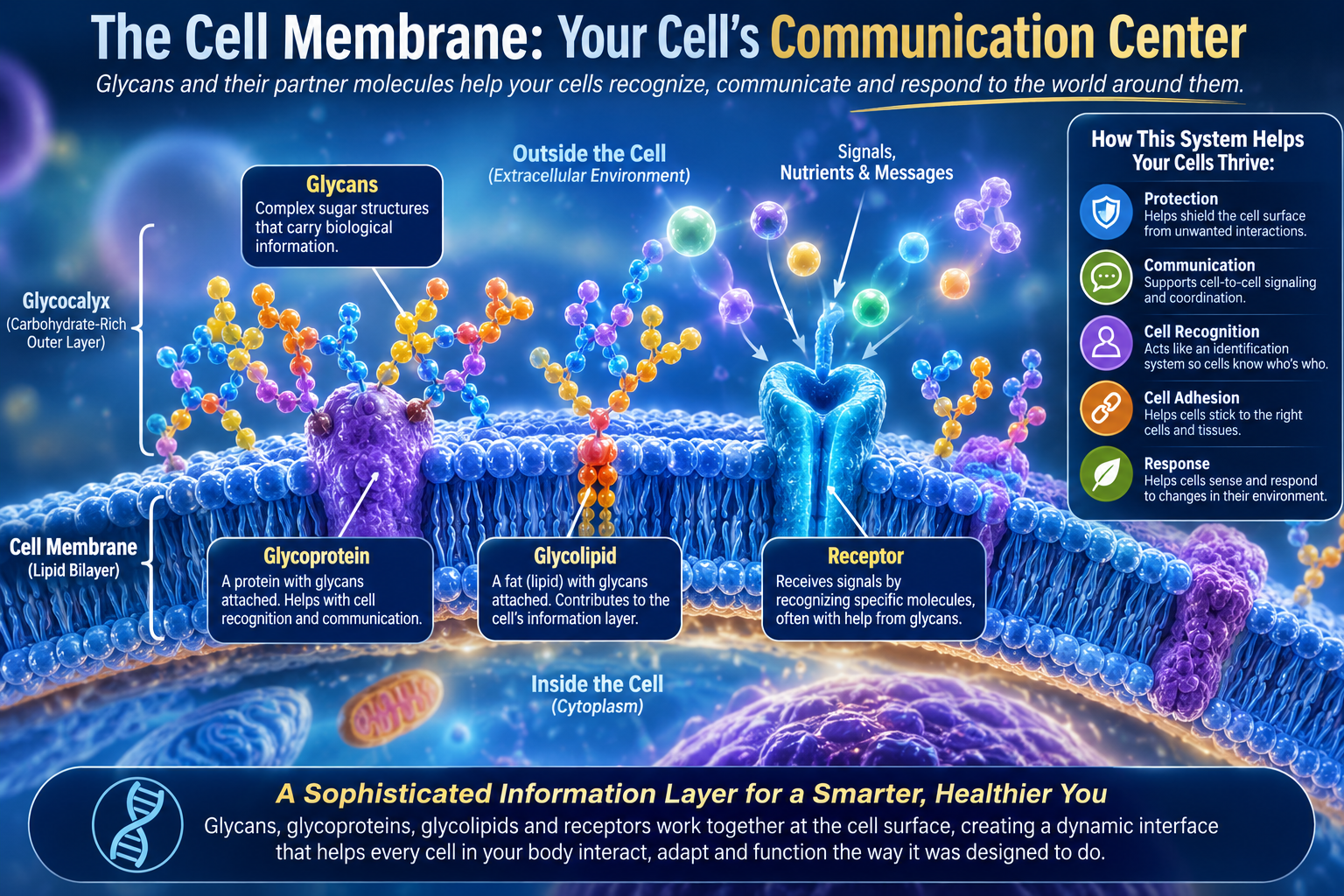
Image: Diagram of a cell membrane showing glycans attached to proteins and fats while receptors interact with signals outside the cell.
The Glycocalyx: The Cell’s Outer Information Layer
The glycocalyx is sometimes described as a fuzzy coat around the outside of the cell.
But that description can make it sound less important than it is.
This outer layer contains an information-dense network of glycoproteins, glycolipids, proteoglycans, and other glycan-containing structures.
Depending on the type of cell, the glycocalyx can participate in:
- protection of the cell surface
- cell adhesion
- cell recognition
- signal transmission
- immune interactions
- responses to physical forces
It stands between the cell and the outside world.
That puts glycans in a strategic position.
Before many outside signals can influence what happens inside a cell, they must first interact with structures at or near the cell surface.
Source: Regulation of Intracellular Signaling by Extracellular Glycan Remodeling
Glycans Can Act Like Biological Identification Tags
One simple way to understand glycans is to think of them as part of a cell’s identification system.
Different cells display different combinations and arrangements of glycans.
Those patterns can help other cells and glycan-binding proteins recognize what they are interacting with.
The analogy is not perfect, but glycans can function somewhat like:
- name tags
- barcodes
- street addresses
- security credentials
The specific pattern matters.
A single sugar unit does not tell the whole story. Glycans can be assembled into branched structures with many possible combinations.
That structural diversity allows them to carry biological information in highly specific ways.

Image: Infographic comparing distinct glycan patterns on different cells to identification tags, barcodes, and biological addresses.
Recognition Is a Two-Part Process
Glycans do not communicate by themselves.
They work through interactions with other molecules.
Proteins known as glycan-binding proteins can recognize particular glycan structures.
When the right glycan and binding protein interact, that connection may contribute to recognition, adhesion, or a cellular response.
It is similar to a lock-and-key system, although real biology is far more complex.
The basic process may involve:
- A cell displays glycan structures on its surface.
- Another cell or molecule encounters those structures.
- A glycan-binding protein recognizes a compatible pattern.
- The interaction contributes to recognition or signaling.
- The receiving cell responds according to its normal programming.
This type of recognition is especially important in interactions involving immune cells, blood cells, tissues, and many other biological systems.
Source: Essentials of Glycobiology — Discovery and Classification of Glycan-Binding Proteins
Why the Immune System Depends on Recognition
The immune system must constantly evaluate what it encounters.
It needs ways to distinguish between:
- the body’s own cells
- damaged or altered cells
- helpful organisms
- potential threats
Glycan recognition is one part of this extremely complex system.
Glycans and glycan-binding proteins participate in interactions that help regulate how immune cells recognize and respond to other cells and molecules.
This does not mean glycans alone control immunity.
The immune system involves genes, proteins, organs, tissues, microbes, hormones, signaling molecules, and many other components.
But glycans occupy an important position at the surfaces where many immune interactions begin.
Source: Glycans and Glycan-Binding Proteins in Immune Regulation

Image: Scientific illustration showing an immune cell examining glycan patterns on another cell as part of normal cellular recognition.
Different Cells Display Different Glycan Patterns
Your body contains many specialized cell types.
Brain cells do not perform the same jobs as muscle cells.
Immune cells do not behave like intestinal cells.
Skin cells operate in a very different environment than cells lining blood vessels.
The glycans found on cell surfaces can vary according to:
- cell type
- stage of development
- location in the body
- metabolic conditions
- signals from the surrounding environment
This is one reason glycobiology is so complicated.
Scientists are not studying one universal glycan that performs one job.
They are studying an enormous and changing collection of structures that participate in many different biological interactions.
The glycans displayed by a cell can change as the cell develops, responds, adapts, or carries out different functions.
The Body Builds Glycans Through Complex Processes
Genes provide instructions for making proteins, but glycans are assembled differently.
Cells use specialized enzymes to build glycan structures step by step.
These enzymes transfer activated sugar components onto proteins, fats, or growing glycan chains.
The raw materials may come from food, be recycled from older biological structures, or be created by converting other sugars inside the body.
This means glycan production depends on a coordinated network involving:
- enzymes
- nutrient precursors
- cellular energy
- healthy metabolism
- proper transport within the cell
Your body can perform this work.
But it still needs adequate biological resources to perform it well.
Source: Essentials of Glycobiology — Glycosylation Precursors

Image: Step-by-step diagram showing specialized enzymes assembling sugar components into branched glycan structures inside a healthy cell.
What Diet Can and Cannot Do
It is easy to oversimplify this subject and claim that eating one food or taking one product directly creates perfect glycans.
Biology is not that simple.
The body digests, transforms, recycles, and assembles nutrients through complex metabolic pathways.
A varied, nutrient-dense diet supports those processes by providing:
- carbohydrates
- amino acids
- healthy fats
- vitamins
- minerals
- phytonutrients
- other naturally occurring food compounds
Food is not a guarantee of any specific health outcome.
But nutrition provides many of the raw materials the body uses to build, repair, communicate, and maintain normal function.
That is why I focus on supporting the entire system rather than searching for one isolated answer.
Why This Science Received Nobel Prize-Level Attention
Glycans are difficult to study inside living systems.
Scientists needed better ways to observe them without interfering with the normal chemistry of the cell.
Carolyn Bertozzi helped develop bioorthogonal chemistry, which allows researchers to track biological molecules, including glycans, inside living organisms without significantly disrupting normal cellular chemistry.
She shared the 2022 Nobel Prize in Chemistry with Morten Meldal and Barry Sharpless for the development of click chemistry and bioorthogonal chemistry.
This recognition did not prove that any particular nutritional product produces a specific health result.
It demonstrated the importance of developing tools that allow scientists to observe and study biological processes that were previously difficult to see.
Why This Matters to Me Personally
For much of my life, I focused on forcing my body to produce more energy.
I pushed harder.
I relied on willpower.
I treated fatigue as something to overpower.
My thinking changed when I began looking at health as a coordinated system.
The body is constantly building, repairing, sensing, communicating, and adapting.
Instead of asking how much more I could force from it, I began asking:
What does my body need in order to perform its normal work more effectively?
That question led me toward better sleep, whole-food nutrition, morning light, movement, stress reduction, recovery, and greater interest in cellular nutrition.
I do not believe glycans alone explain my transformation.
I believe they are one important part of a much larger biological picture.

Image: Lenny Morgan enjoying a peaceful morning in natural sunlight, representing the shift from forcing the body to supporting it.
A Careful Word About Glycan Nutrition
The importance of glycans in human biology does not automatically prove that every person needs a particular supplement.
Those are two separate questions.
The biological science is well established:
- Glycans are widespread throughout the body.
- They are commonly found on proteins and fats.
- They participate in recognition, signaling, adhesion, and other normal functions.
The nutritional question is more individual.
No product replaces:
- a nutrient-dense diet
- adequate sleep
- regular movement
- hydration
- stress management
- medical care when needed
I am interested in support, not hype.
I look for transparent companies, responsible claims, quality ingredients, and third-party research whenever possible.
What I Believe Today
Glycans are found on nearly every cell because cells must continuously interact with the world around them.
They need to identify.
They need to recognize.
They need to communicate.
They need to respond.
Glycans help create the information-rich surface where many of those interactions occur.
They are not a cure-all.
They are not a substitute for the foundations of health.
They are an essential and fascinating part of human biology that most people have never been taught to consider.
And the more we understand how the body works, the better equipped we are to make thoughtful decisions about how we support it.
Want to Learn More?
If you are interested in learning about the food-based source I have personally trusted for years as one way to support this area of nutrition, you can learn more here:
No product is required for everyone. Review the information carefully, consider the quality of the evidence, and make the decision that is right for you.
If you have questions about glycobiology, cellular communication, or my own health journey, email me directly.